

A Journey Through History, Science, and Faith
E. June Turner

Chapter 1
Conflicted Foundations
My earliest memories of faith and religion are from when I was about six to eight years old. At that time, I was being raised in two very opposite denominations. My uncle by marriage was a pastor, and while my own parents were not overtly religious, my stepmother was a member of the Catholic Church. Sometimes I wonder what would have happened if I hadn't had that confusing inclusion of the Holy See in my early religious education.
Of those earliest years, I remember one thing very clearly: I absolutely believed in God and the Son. It wasn’t difficult to believe—until I began learning about science and history. I loved Christmas, would sing Christmas carols incessantly, and prayed. Oh, how I prayed. I still can’t pray the way I used to and wish I could get back to that innocent, certain faith of a child.
I went from that to falling completely away from Christianity in just two short years at a very young age. Part of it was being raised in those two differing sects. When visiting my Aunt and Uncle’s, I would participate in their children’s groups and worship services. At home, I would have to go to St. Michael’s for Mass and the traditional Sunday school. My biblical education was conflicted, and then my regular schooling introduced yet another conflict.
My Baptist education taught me that idol worship was a sin against God, while my Catholic education told me to pray to Mary when confessing my sins. I don’t remember exactly how old I was, but I was in First Communion when I stopped being Catholic. I never finished communion, and I didn’t really go back to Mass either. As for my Aunt and Uncle’s church, they moved to another state so my religious education essentially stopped.
I remember when a complete stranger asked me if I had accepted my Savior while I was at Toys"R"Us with my mom one year shopping for Christmas. The lady came out of nowhere when my mom had gone around a corner, crouched down, and asked, “Child, have you accepted Jesus Christ as your Lord and Savior?” I don’t remember if I answered her. I just know that at one time I had, but suddenly I wasn’t so sure anymore. That interaction solidified my falling away from organized religion, but it took entirely different teachings and interactions to wrench me away from the Church altogether.
The Bible taught us that everything was created in six days, and on the seventh, God rested—literal days, mind you. Jurassic Park was still a few years away, but we were already being taught in school that all life originated from a single-celled organism and that dinosaurs died off millions of years ago. How could the Bible possibly be true if the experts—the scientists and archaeologists—said things were actually millions and billions of years old? For a child, that was a massive contradiction.
I was an apostate from His Church by the time I was eight years old. By the time I was ten, I was reading about ancient religions and mythologies, trying to find for myself where it all began. I asked a friend at the time how he knew God existed, and he told me to just look around—everything in nature bore His fingerprints. It would take me several decades to finally understand what he meant.
Chapter 2
Searching for the Beginning
Up through high school I continued plodding away at the mystery of religion. I had determined that because all mythologies existed in the past, then, in the future, the religions of today would also be considered mythologies. The Big Bang Theory and Evolution were taught as unquestionable truth—the law of the land. We weren’t presented with any alternate theory of life or creation in science class. If there was science or archaeology that supported the Bible, it was not widely taught and was far less known. In fact, I recall hearing over and over again how something disproved the Bible—even if that thing wasn't ever proven either.
Looking back, I feel let down by those institutions. It wasn’t just my schools—it was Bill Nye the Science Guy, it was NOVA, it was the Discovery Channel—adding to my secular schooling. And I dare say it applies to most of us city raised Gen X and Millennial children. I wanted to believe that all belief systems were simply fabricated by men in the ancient world, because that’s how secular science framed our history.

In my early twenties through my thirties, I dabbled in other belief systems, but I always reverted to the atheistic and secular teachings of the modern day. I explored Wicca, Buddhism, and eventually even Islam. My library checkouts were full of books on ancient beliefs, mythologies, and origin stories.
Then came UFOlogy. Our friend Giorgio Tsoukalos—a name so ingrained in my memory that I can spell it without looking it up—introduced me to the writings of Zecharia Sitchin. I became completely engrossed in The Lost Book of Enki. I spent hours listening to audio readings on YouTube and studying the story of Gilgamesh, along with other ancient flood myths. I was determined to find, for myself, the exact point where the foolish notion of all-powerful gods began.
What was I searching for? Something that made sense. Something with the ring of truth. I had gone back to the very beginning—six thousand years ago—to the first recorded civilization. What I found there wasn’t the neat, tidy origin story I expected. Instead, it was a tangled web of overlapping accounts—ancient kings, great floods, strange beings, and stories that sounded eerily familiar. And that’s when the comparisons to the Bible started to take shape in my mind…
Chapter 3
The Cracks Begin to Show
While many social media channels, YouTube documentaries, and popular articles like to claim that the first books of the Bible — especially Genesis — were just copied from older Mesopotamian sources such as the Epic of Gilgamesh or Sumerian and Akkadian traditions, that’s oversimplifying it. Yes, there are similarities. The creation and flood accounts in Genesis do echo parts of those older stories, and scholars agree that Jewish scribes during the Babylonian Exile in the 6th century BCE would have been exposed to Babylonian myths, laws, and literature.
But the best historians don’t reduce it to plagiarism. They recognize these as shared cultural threads from the ancient Near East — threads the biblical writers reworked, sometimes completely reversing their meaning, to reveal a radically different worldview: one God, one Creator, and a moral order rooted in His nature. The Exile may have been a time when portions of the Torah were compiled or edited, but the roots go deeper — to older Israelite oral traditions and the broader cultural environment in which they lived.
I had also encountered the claim that Zoroastrianism was the first true monotheistic faith. That sent me digging again. Zoroastrianism traces back to a man called Zoroaster, or Zarathustra, in ancient Persia — possibly as early as 1800 BCE, possibly as late as 600 BCE. It centers on a supreme god, Ahura Mazda, but it isn’t monotheism in the same way as Judaism. At its core is a cosmic dualism: truth and order (asha) locked in constant battle with falsehood and chaos (druj), personified by the evil spirit Angra Mainyu.
Judaism’s roots reach back further, to God’s covenant with Abraham around 2000 BCE in Canaan. It is strict monotheism — no equal and opposite god of evil, only a created adversary under God’s ultimate authority. Where Zoroastrianism focuses on maintaining cosmic order through moral choice and ritual purity, Judaism builds everything on the Torah — God’s covenant law, governing worship, morality, family, and community life.
Some ideas overlap — resurrection, final judgment, the triumph of good over evil — and Persian influence during the post-exile period likely left some marks. But the heart of the two faiths is different: one is dualistic; the other affirms the sovereignty of one God over all creation.
With modern pop culture’s influence, the idea of advanced alien beings influencing early humanity can sound more “plausible” than a Creator. Ancient astronaut theories have been circulating for decades, offering a sensational but tidy explanation for ancient monuments and advanced knowledge. But when I compared the Lost Book of Enki to Genesis — and even to extra-biblical works like the Book of Enoch — I could see the same framework. Different names, different cultural dressings, same storyline. The so-called “alien” beings looked an awful lot like the “sons of God” in the Hebrew Scriptures.

Ironically, Zecharia Sitchin’s way of telling the story made Genesis begin to make more sense — not less. I even flirted with the teachings of the late Rob Skiba for a while. His work often blended Scripture with alternative history, Nephilim theories, and interpretations of Genesis that tried to bridge the Bible with certain elements of accepted science. It was fascinating, and for a while I thought I’d found a middle ground between faith and the mainstream narrative. But in the end, it still rested on the same secular timelines and assumptions I had already begun to question.
And then I found the kind of evidence that doesn’t just make you curious — it shakes the ground under your feet.
Chapter 4
History Comes Alive
Two documentaries — along with the research they led me to — made me stop in my tracks and re-examine everything I thought I knew.
The first was The Exodus Decoded (2006) by James Cameron and Simcha Jacobovici. This wasn’t just another dramatization of Moses and the plagues; it was a deep investigation into archaeology and geology, comparing biblical accounts with physical evidence. They didn’t strip the miraculous out of the story. Instead, they showed how God could have worked through the natural world He created.
They proposed that the ninth plague — the “palpable darkness” — could have been caused by volcanic ash from the Thera (Santorini) eruption, blotting out the sun. They explored how a limnic eruption in the Nile Delta — a sudden release of deadly gas from deep underground — could explain a massive die-off of fish and livestock. Step by step, they took each plague in biblical order and matched it with plausible events from the same general timeframe. It didn’t weaken my faith — it made it stronger.
.png)
Around this time, I discovered the work of Dr. Robert Schoch. Not a biblical creationist, but his studies of catastrophic events and worldwide flood myths were compelling. Across the globe, cultures told strikingly similar flood stories. The more I read, the harder it was to believe these were just isolated local events. The global consistency pointed toward a single event — one worldwide flood.
Later, I would encounter the research of Dr. Andrew Snelling, a geologist with Answers in Genesis, whose detailed work on geology and sedimentary layers reinforced the biblical account of a global, cataclysmic flood. His findings provided the kind of scientific depth that tied the physical record to the scriptural record seamlessly.
And then there was Expedition Bible. Dr. Todd Bolen and his team went to the very sites where biblical events took place — or should have taken place — and over and over again, the evidence was right there. Ancient walls, inscriptions, city ruins, burial sites… the Bible was literally coming to life in front of me. They didn’t chase easy wins; they engaged the hard, debated sites, and the evidence still matched.
By the time I had absorbed the historical alignment of The Exodus Decoded, the geological insights from Schoch and Snelling, and the on-the-ground confirmations from Expedition Bible, I was already well on my way to leaving my Atheistic worldview behind.
Chapter 5
Cracks in the “Settled Science”
The final blow came when I realized just how much of the secular worldview was held together by assumption.
The Big Bang and Darwinian Evolution — the two pillars of the story I was taught to accept without question — were still, at their core, theories. Evolution, especially macroevolution — the belief that entirely new kinds of life arise over vast ages — rested on interpretations, speculation, and sometimes outright leaps of faith. Every time evidence contradicted the narrative, the theory was patched with a new “just-so” explanation.
The Big Bang fared no better. In school, it had been presented as if scientists had witnessed it. But the deeper I looked, the more it revealed to me the contradictions, revisions, and “unknowns” glossed over with equations that only worked if you already accepted the conclusion. No one had seen it happen. No one had reproduced it. Yet it was treated as an untouchable truth.
Comedian Pete Holmes summed up the absurdity of the secular notion in one joke: “Well, before there was something… there was nothing… and then nothing exploded.” A magical nothing indeed.
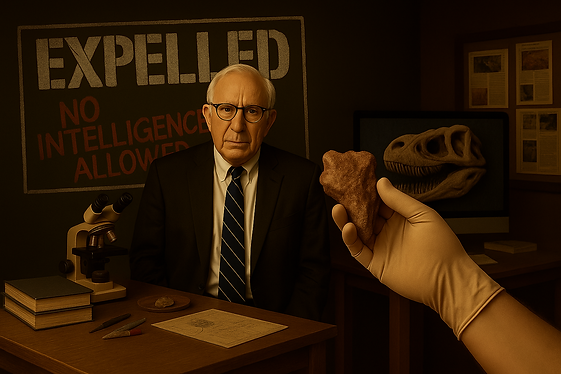
Then came Ben Stein’s Expelled: No Intelligence Allowed (2008). This wasn’t archaeology or theology — it was an exposé of the unspoken rule in science: you don’t question Darwin. Stein documented case after case of qualified scientists losing their positions, funding, and reputations simply for considering Intelligent Design.
And then the bombshell — soft tissue in dinosaur fossils. According to the evolutionary timeline I had been fed since childhood, these fossils were tens of millions of years old. But here, on camera, were flexible blood vessels and identifiable cells inside a 68-million-year-old T. Rex thighbone. That shouldn’t be possible. Soft tissue decays far too quickly. And it wasn’t a one-off. More fossils with similar findings followed.
By then, there was no going back. Archaeology, geology, and the unraveling of “settled science” had left me standing face-to-face with evidence that confirmed Scripture rather than contradicting it. The Bible wasn’t just holding its ground — it was the only explanation that made sense.
Ch.6 –
From Arguments to Anchors
So what led me to Judaism? It was Torah. Many Christian denominations don’t put much emphasis on what they call the “Old Testament,” and some even teach that you only need to focus on the New. But that’s not what Yahushua taught. He didn’t say that only His own words mattered — He said His teachings fulfilled the Torah (Matthew 5:17–19). You can’t truly understand the New Testament without knowing the foundation it was built on.
Some forty years after Yahushua’s ministry, the Temple was destroyed — just as He had prophesied (Matthew 24:1–2; Mark 13:1–2; Luke 21:5–6). With that destruction, the Jewish people lost the ability to fully atone for their sins through the sacrificial system prescribed in the Torah. That was why He came — to be the once-and-for-all atonement, redeeming anyone who believes in His death as the payment for the sins of mankind, for those who “do not know what they do” (Luke 23:34).

By this point, I had crossed a line. I no longer viewed Intelligent Creation as simply “an alternative” to the secular model — it was the only model that held up under evidence and logic.
Chapter 7
Why Torah Brought Me Home
I had spent so many years arguing against God, and now here I was — a steadfast believer in an Intelligent Creator. Creation scientists from Answers in Genesis, the Institute for Creation Research (ICR), Creation Ministries International, and others gave me the information I needed to reconcile my logical, evidence-driven mind with the factual miracle of Creation. They didn’t shy away from the hard questions, and they didn’t settle for “just believe.” They showed me how the evidence in nature, archaeology, and genetics consistently confirmed what the Bible had declared from the very beginning.
The more I dug in, the more UFOlogy began to look… silly. The idea of “perpetual seeding” of new worlds wasn’t an answer — it was just a belief without a beginning. Like Ken Ham has pointed out, if your god came from a bigger god, then you just have a bigger god… and then a bigger god before that… stretching into eternity without ever reaching a true starting point. UFO theories end up in the exact same trap. These so-called alien beings would themselves have to be created, which means you just get bigger aliens, and then “trans- or multi-dimensional beings,” and so on — never actually arriving at a moment of creation.
When I put the Big Bang under the same lens, it began to sound downright ridiculous. Random nothing exploding into something, then into life, then into complex order — all by sheer accident? That took far more blind faith to believe than the Bible’s straightforward account: “In the beginning, God created the heavens and the earth.”

It was through studying the Torah that the pieces began to click into place for me. The more I learned, the more the rest of Scripture came alive. And it wasn’t just my own reading — I was blessed to find resources that made it real and practical. One for Israel on YouTube opened my eyes to how Jewish believers in Jesus read and apply the Scriptures. Torah Class walked me through each portion, connecting it to both the ancient world and my own life. The Tree of Life Bible Society gave me a Messianic translation that preserved the richness of the Hebrew, letting me read the Word in a way that felt more authentic to its origins. Answers in Genesis gave me the scientific and historical evidence that backed up the biblical account. Together, these voices challenged what I had been taught as a child and showed me the Bible as a seamless whole — from Genesis to Revelation.
I came to believe that Torah is not just helpful, but essential, to understanding the teachings of the Messiah. Without it, you miss the cultural, historical, and prophetic context that gives weight to everything He said and did. Strangely enough, much of what I learned through Christian Apologetics actually affirmed this belief for me. In defending the reliability of Scripture, many apologists were — sometimes without realizing it — defending the very Torah they rarely emphasize. When they proved the accuracy of biblical prophecy, they were confirming the prophetic framework that rests on the Torah. And in refuting secular claims against the Bible’s history, they were defending the very foundation Yahushua Himself said He came to fulfill.
I began to see the unbreakable connection between God, Israel, and the land promised to them. God separated and chose Israel because He knew they would preserve His Torah. He chose them to record the words of His prophets — in doing so, recording His Word. He chose them because they would fulfill His prophecies — and they have, even to this day.
Likewise, God used Gentiles to spread His Word to the nations, also fulfilling prophecy. There is still more to come, and that is why I am sharing my story. I hope to reach the doubters, the fence sitters, and those who place more faith in ideology than in God Himself — to point them toward the One in whom the answers can be found.
Chapter 8
From Searching to Sharing
When I look back over the decades, I see a trail littered with questions, detours, and dead ends. I see the child who believed with all her heart, the young girl who walked away when the world’s “truth” seemed more convincing, and the adult who chased every alternative explanation in an effort to make sense of it all. I see the nights I spent reading, the hours I poured into documentaries, the rabbit holes that led nowhere, and the quiet moments when I was still enough to hear God calling me back.
What I didn’t realize then was that every step — even the wrong turns — was leading me somewhere. My time in Catholicism, my brush with Baptist teaching, my wanderings through Wicca, Buddhism, Islam, UFOlogy, and ancient mythologies — all of it sharpened my hunger for truth. It forced me to examine evidence, test ideas, and refuse to settle for “just believe” or “don’t ask questions.”
And when the answers began to line up — archaeological finds, historical patterns, genetic science, flood accounts from every corner of the globe, prophecy fulfilled before my eyes — the Bible I had doubted became the Bible I could no longer deny. I didn’t just return to faith; I returned with my eyes open, my heart anchored, and my mind satisfied that the God of Abraham, Isaac, and Jacob is exactly who He says He is.
Now I stand as a Messianic believer — not because it’s trendy, not because it’s easy, but because I know the Torah is the foundation my Messiah built upon. I follow Yahushua not as a departure from the Law, but as its perfect fulfillment. I hold to the Word — from Genesis to Revelation — as a seamless whole, inspired by the Creator who spoke it into being.
That conviction is what gave birth to Light the Fire Ministries — the Judeo-Christian branch of Light the Fire Books, an online used bookstore based in Chadron, Nebraska. Our vision is to grow into a brick-and-mortar store that is not only a place to find books, but a hub where seekers of all backgrounds can encounter the truth of Scripture for themselves. We hope to partner with Christian and Creation organizations to offer their books and products, distribute materials, and host courses for those who need more than just a website — for the lost sheep who still need a shepherd.

In the meantime, we are focused on producing video releases for 2026 — a visual journey that brings the opening chapters of Scripture to life in a way no one has ever seen before. It will be historically, scientifically, and biblically grounded, blending archaeological discoveries, creation science, and Torah teaching into a single, cohesive narrative. This work is designed to challenge the mainstream narrative, engage the skeptic, and strengthen the believer.
There are still prophecies yet to be fulfilled, and the story is not over. My prayer is that my journey — and this ministry — will serve as a spark for those still searching to kindle their faith. If you are doubting, questioning, or standing on the fence, I hope what we share will encourage you to look deeper. Don’t be afraid to follow the evidence wherever it leads. You may just find, as I did, that it leads you straight to the Author of it all.